


Just over a month before the end of 2024, *The Economist* released its traditional annual issue featuring an overview of the trends that, according to the publication, will become the key drivers of major economic, political, and social developments in the coming year.
The cover of *The World Ahead 2025* once again fuels the imagination of those fascinated by conspiracy theories, hidden meanings, and secret predictions. However, even if you do not share such views, decoding the visual puzzles created by the magazine’s designers remains a fascinating exercise.
<
The main figures depicted on the magazine cover have remained almost unchanged compared with the previous edition. Just as in 2024, the central characters are world leaders whose actions have been closely watched globally for several years. The hourglass, the ballot box, the image of the Earth, and several other symbolic elements have also remained. We will return to them later, but first, let us examine what has changed on a broader level.
First of all, the color palette.
While the 2024 forecast cover relied heavily on blue, red, and black tones, the new edition is dominated almost entirely by red and black imagery. Where has the blue gone — the color traditionally associated with security, stability, and trust?
Obviously, this may be the first hint that 2025 will become a year of even greater tension. Red is a color associated with danger, excitement, passion, power, and aggression. It conveys emotional intensity, immediately captures attention, and demands a stronger response from the viewer.
This sense of tension is reinforced by the downward and upward graphs and lines scattered across the cover. Could this be a reference to the global economic shocks that the world may face in 2025?
Who, according to *The Economist*, could become the main source of instability?
Most likely — the newly elected President Donald Trump, whose image is positioned at the center of the collage.
Although, strictly speaking, the figure depicted is not Trump alone. But more on that later.

It is worth noting that on the cover of the previous *The Economist* annual forecast issue, the image of the sitting U.S. president was placed against a blue background.
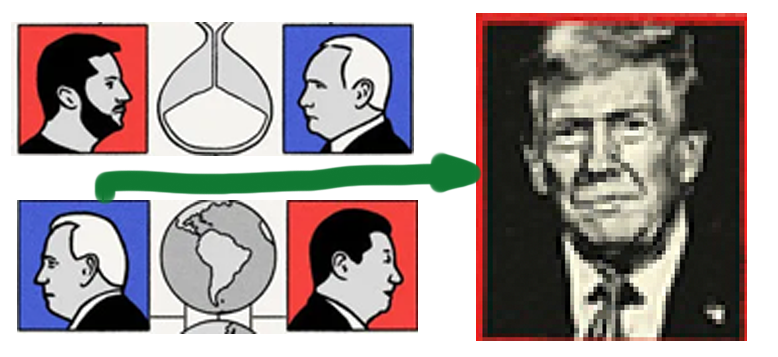
A clear connection can be seen with the major challenges awaiting the new U.S. administration in the coming year. These include strengthening the position of the dollar as the world’s primary financial instrument, reducing the enormous national debt, and addressing excessive government spending.
There is little doubt that Trump’s policies will play a significant role in shaping 2025. The question is whether this new political course will bring greater security and confidence — not only for the United States but for the world as a whole. We will find out very soon.
The entire collage is clearly divided into two parts, most likely symbolizing the confrontation between two major geopolitical and economic poles — the West and the East, Europe and the United States versus China and Russia.

Now take a closer look at this image.
Do you notice anything unusual?
Besides the six portraits of individuals directly influencing global events (not counting Jane Austen at the bottom of the collage), there appears to be another “face.”
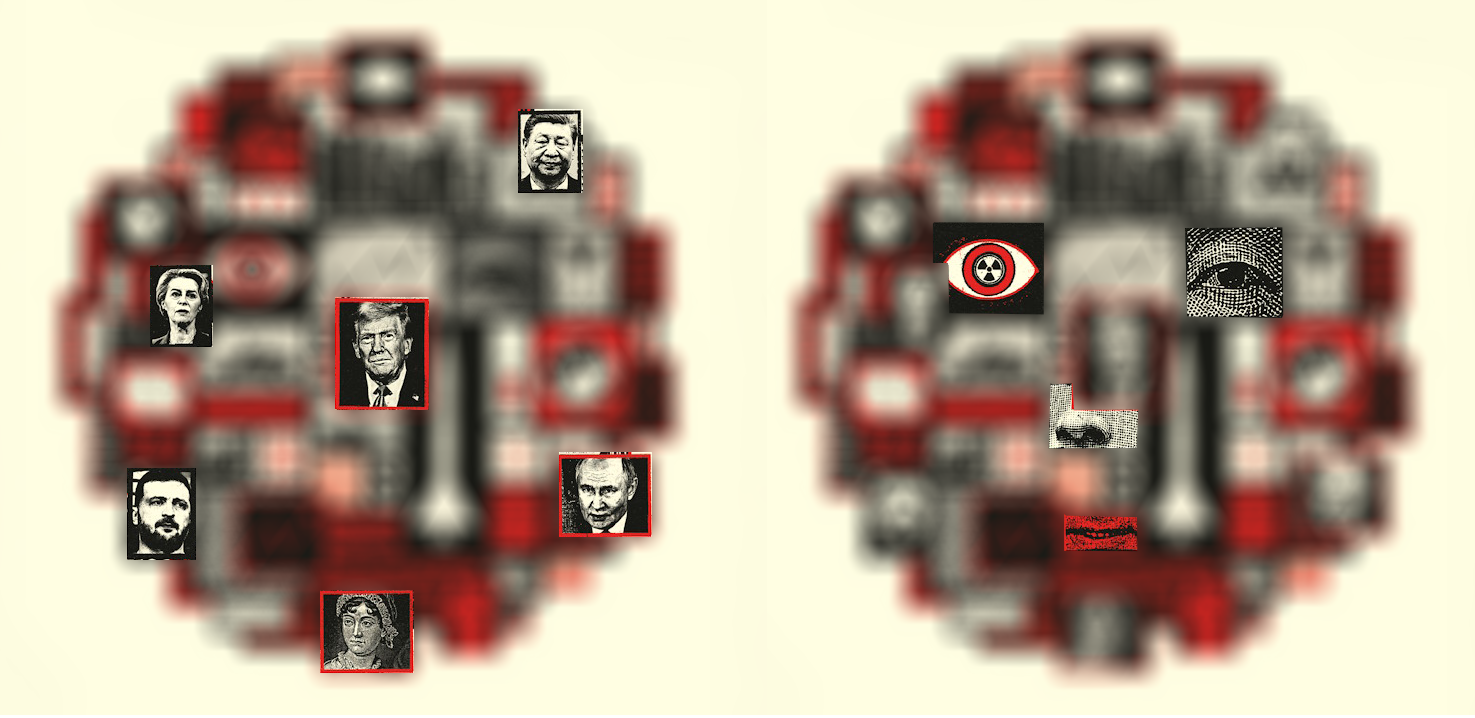
What could it be?
A hidden message for supporters of conspiracy theories and the idea of a “shadow government” — those who believe that modern global decisions are not actually determined by the leaders of major countries, but by a group of influential figures operating behind the scenes?
Perhaps.
It is also worth noting that Chinese President Xi Jinping (top right), European Commission President Ursula von der Leyen (top left), and Ukrainian President Volodymyr Zelenskyy (bottom left) are framed in black, while U.S. President Donald Trump (center) and Russian President Vladimir Putin (bottom right) are framed in red.
In politics, red is traditionally associated with freedom, courage, determination, and action.
At the very bottom of the collage, we find the image of Jane Austen.
At first glance, it may seem unclear what role a long-deceased novelist could possibly play in shaping the global events of 2025. However, her portrait is not placed among world leaders by accident — especially not at the bottom of the composition.
This is a clear reference to Austen’s most famous novel, *Pride and Prejudice*, which taught generations of readers the importance of making the right choices, overcoming arrogance, and remaining committed to timeless values even in the most difficult circumstances.
And here it is impossible not to recall one of the novel’s most thought-provoking passages:
The more I see of the world, the more I am dissatisfied with it; and every day confirms my belief of the inconsistency of all human characters.
Now, let us take a closer look at the details.
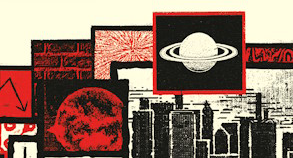
In 2025, astronomers will observe two remarkable phenomena: the temporary disappearance of Saturn’s rings and a total lunar eclipse, often referred to as a “Blood Moon.”
In Greek mythology, Saturn is associated with the god of time — a figure who judges humanity and punishes violations of moral order. Meanwhile, the Blood Moon has traditionally been interpreted as a symbol of blood, wounds, and struggle against evil, often connected with expectations of dramatic change or even an approaching apocalypse.
The disappearance of Saturn’s rings is caused by the planet’s specific orbital position, which makes the rings almost invisible from Earth. For astronomers, this creates a unique opportunity to observe structures normally hidden behind the rings.
It is particularly interesting that both events will occur in March of the following year. Could this represent a symbolic message suggesting that humanity may witness revelations, uncovering facts that were previously hidden from public view?
Even more intriguing is the placement of these two elements at the very top of the collage. This may be interpreted as a reference to the *Emerald Tablet* attributed to Hermes Trismegistus, which expresses the philosophical principle:
*“As above, so below; as within, so without.”*
A concept suggesting that events occurring on a cosmic scale may reflect deeper processes taking place within human society.
So, what events, according to the creators of the cover, will shape the global landscape in 2025?
The following elements of the collage appear to provide possible answers.
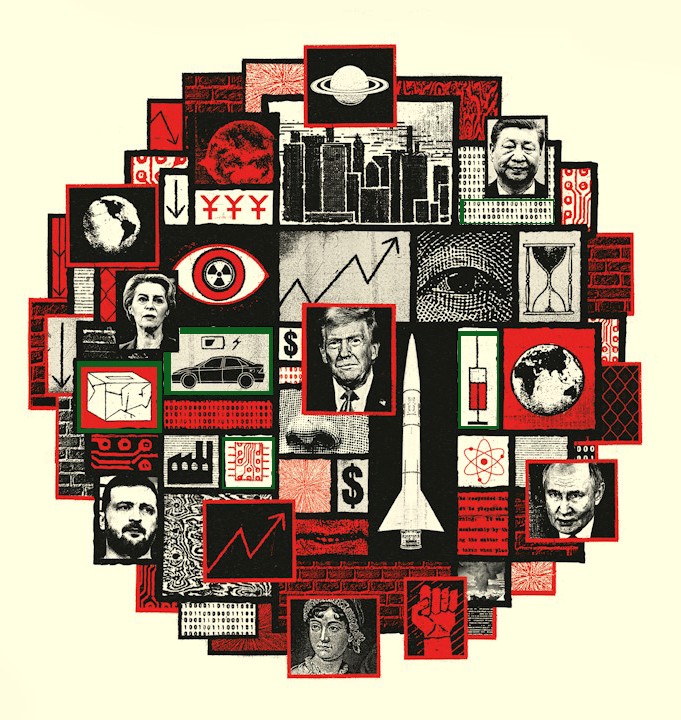
- The continued development of artificial intelligence technologies (represented by binary code and microchips);
- The confrontation between renewable “green” energy and traditional energy sources (symbolized by an electric vehicle with an empty battery);
- The potential spread of new epidemics (represented by a syringe);
- Elections in different regions of the world (represented by a cracked ballot box).
A massive rocket pointing toward a city is an obvious symbol of growing global tensions connected with military conflicts and the possibility of nuclear escalation.
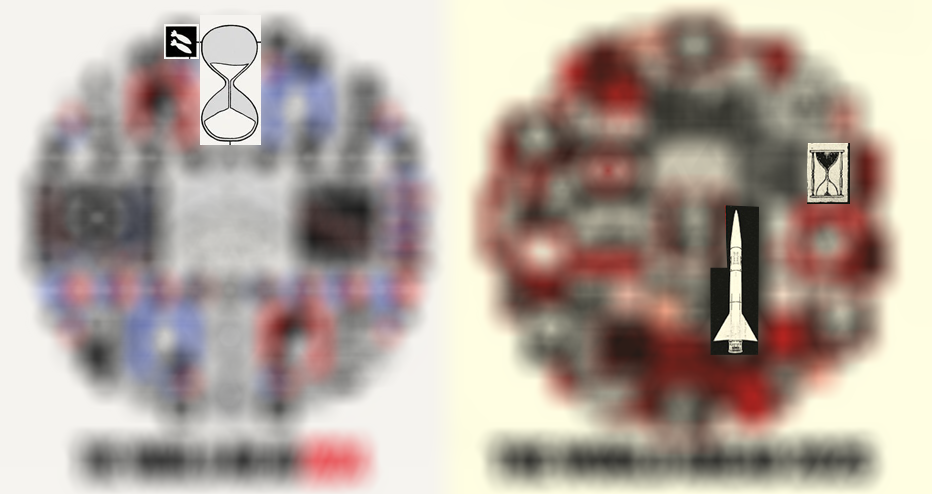
Near the rocket, just as in *The World Ahead 2024*, we once again see an hourglass.
However, this time the symbolism appears to have changed. Previously, the grains of sand had almost completely moved from the upper chamber into the lower one. Now, we see the opposite process — the sand appears to be moving upward.
Could this represent a second chance for humanity to avoid destruction in a nuclear catastrophe?
Perhaps. Much may depend on the decisions of the leaders of the United States, Russia, and China — precisely the countries whose representatives occupy this section of the collage.
Interestingly, in the left part of the composition, there are no downward arrows at all, while the right side contains several.

What could this mean?
A message suggesting that Europe’s economic position will continue to deteriorate in 2025?
Most likely, yes.
After all, besides the downward indicators, around the image of Ursula von der Leyen we can see a broken ballot box and a black nuclear power plant symbol.
And this brings us back to the image of Donald Trump.
It is not entirely Trump — although the association with the newly elected U.S. president placed at the center of the collage is obvious and logical.
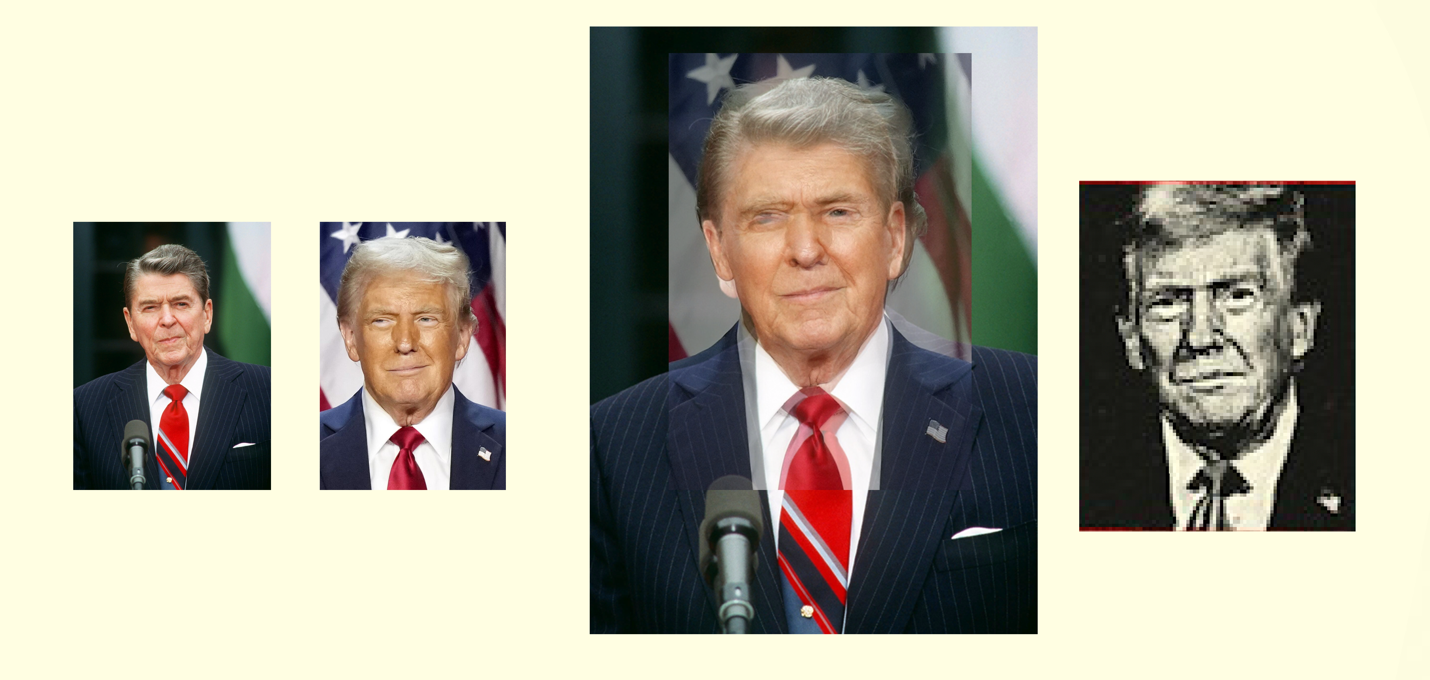
The creators of the image combined Trump’s features with those of another American president — Ronald Reagan.
The distinctive lips, facial lines, hairstyle, and even the ears all suggest that this is a composite portrait.
But why Reagan?
Reagan, like Trump, was elected to the presidency twice — in 1980 and 1984 — and was also a Republican.
During his presidency, the term “Reaganomics” was introduced to describe his economic policy approach, which focused primarily on supply-side economics. Reagan shifted the emphasis away from managing demand for goods and services toward stimulating production and economic growth.
His administration was built around the idea of a “supply-side economy”: reducing barriers for businesses, encouraging investment, and cutting government spending.
The comparison between Trump and Reagan clearly sends a message to the viewer: with the beginning of Trump’s new term, the United States may pursue a policy aimed at strengthening its own position — both domestically and internationally.
It is also worth remembering that Trump’s famous campaign slogan:
“Make America Great Again”
was not entirely new. A similar phrase had already been used during Ronald Reagan’s presidential campaign in 1980.
The symbolism of combining the two presidents therefore appears deliberate: it suggests a return to a period of economic nationalism, deregulation, and a focus on strengthening America’s influence on the global stage.
—
Conclusion
The cover of *The Economist’s The World Ahead 2025* clearly suggests that the coming year will be a challenging one.
The colors, the arrangement of figures, and the carefully selected symbols once again encourage viewers to search for deeper meanings behind the image.
It is another reminder of the famous quote by Dale Carnegie:
Most of the important things in the world have been accomplished by people who have kept on trying when there seemed to be no hope at all.
And therefore, despite all uncertainty and challenges ahead, we should continue to hope for the best.

